Why Does My Stress Score Say I'm Stressed When I Don't Feel It?
A wearable stress score is not measuring how stressed you feel. It is measuring your heart's autonomic activity, mostly through heart rate variability (HRV), and that signal moves for reasons that have nothing to do with your emotional state. That mismatch is normal, and it is one of the most common complaints wearable users bring up.
What is a wearable stress score actually measuring?
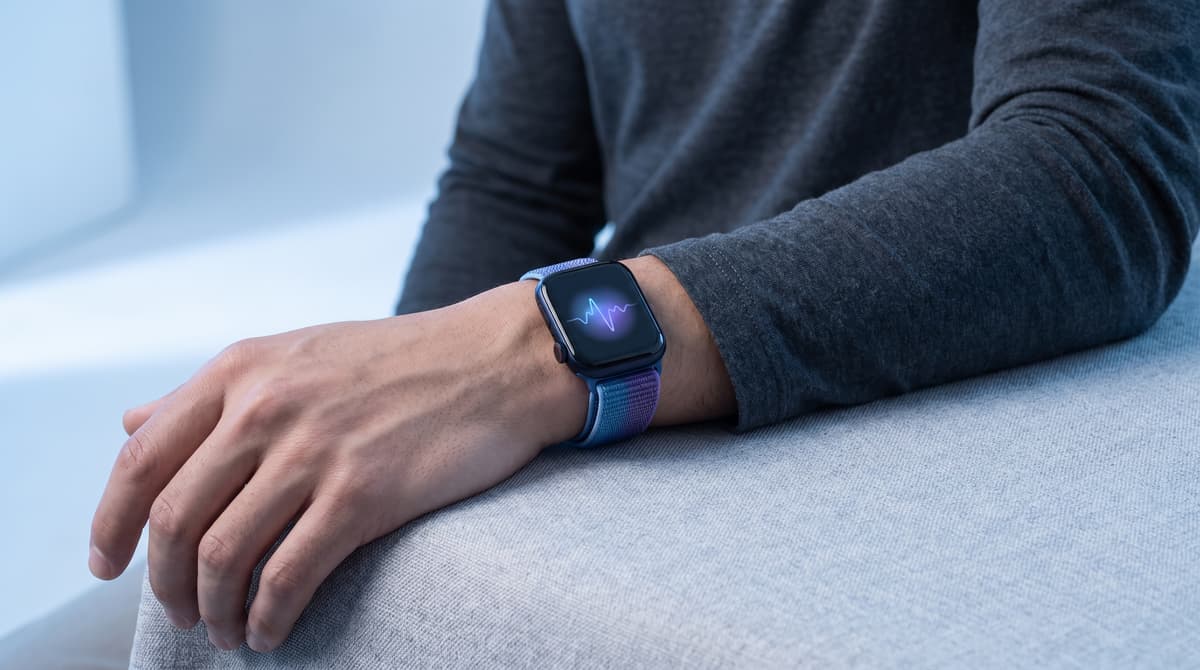
Garmin, Oura, Fitbit, and most other brands build their stress score around HRV, the variation in time between your heartbeats. When your sympathetic ("fight or flight") system is more active, that variation tends to shrink. When your parasympathetic ("rest and digest") system dominates, it tends to grow. Research on psychological stress consistently finds this pattern: periods of stress most often come with lower HRV, driven by reduced parasympathetic activity (Kim et al., 2018).
The problem is that HRV is affected by far more than emotional stress. A review of wearable and research devices found that HRV, and therefore any stress score built on it, is shaped by breathing, time of day, posture, age, sex, physical activity, alcohol, and even some medications (Kim et al., 2018). The score cannot tell your brand new deadline apart from a brisk walk, a big meal, or a bad night of sleep. It only sees the downstream effect on your heart.
Why doesn't my score match how I feel?
Because the two are only weakly connected. In a cross-sectional study of 221 overweight, psychologically distressed adults wearing a Firstbeat-based chest recorder, researchers found that self-reported stress and the device's physiological stress reading were associated, but the association was weak and the two appeared to be shaped by different factors (Föhr et al., 2015).
This cuts both ways. You can feel calm while your score reads high, because something physical, not emotional, pushed your HRV down. You can also feel anxious while your score reads low, because the physiological signature your device is trained to catch simply did not show up that day. Neither direction means the score, or your feelings, are wrong. They are measuring different things.
There is also a sizing problem. Studies that have tried to quantify the HRV change tied to everyday, in-the-moment stress find it is often small and inconsistent from person to person. One smartwatch study of 90 adults found higher momentary stress went with an RMSSD (a common HRV measure) only about 2 milliseconds lower on average, with a steeper drop in people who already had higher baseline HRV. A separate study tracking police officers for months found the relationship between HRV and stress-related outcomes was weak to moderate and not consistent across individual participants. A shift that small is easy for other influences to swamp entirely.
What else moves the number besides emotional stress?
A lot. Here is what commonly shows up as "stress" to your wearable:
| Common cause | Why it changes HRV |
|---|---|
| Exercise or exertion | Raises sympathetic activity the same way stress does |
| Alcohol the night before | Shifts the nervous system balance for hours afterward |
| Illness onset | The body mounts an autonomic response before symptoms appear |
| Caffeine | Stimulates the same nervous system pathway |
| Standing up quickly | Triggers a brief autonomic spike unrelated to mood |
| Device fit or motion | Noisy heart rate signal reads as erratic HRV |
| A big meal | Digestion shifts autonomic balance temporarily |
Device makers themselves acknowledge this. Even though stress algorithms try to filter out detected exercise, same-day movement can still bleed into the reading. In one 90-day study of nurses wearing Garmin devices, each additional 1,000 daily steps was associated with roughly a 1-point rise in the stress score, even though workouts were excluded from the calculation. A separate large workforce study found the opposite pattern with habitual activity over time: people who were more generally active had lower HRV-based stress. Same underlying signal, different exposure window, different result. That inconsistency alone tells you the score is not a clean emotional thermometer.
Average heart rate, which some simpler devices still lean on, is a weaker stress signal than HRV. A review covering stress and anxiety detection studies found that average heart rate used by many commercial devices was less accurate at detecting stress than HRV or skin conductance measures. Reviews of wearable AI models built to detect stress describe the field as "promising" but still limited by small datasets and inconsistent labeling, meaning the accuracy ceiling for any single score is lower than marketing might suggest.
Does a high stress score mean something is wrong?
Not by itself. A low HRV reading, or a high stress score, does not mean you are stressed and it does not point to any mental health or medical condition. HRV reflects overall autonomic activity, not a diagnosis, and the same reading can come from a workout, a drink, or getting sick as easily as from a bad day. If you are struggling to cope, or if feelings of stress interfere with daily life and will not go away, that is worth bringing to a health professional regardless of what any wearable shows.
Can the score still be useful?
Yes, as a trend, not a verdict. A single reading tells you almost nothing on its own. A pattern over days, especially one that lines up with something you can name, like travel, poor sleep, or heavier training, is more informative than any single number. Treat the score as a prompt to ask what changed, not as a readout of your emotional state.
This is exactly the kind of context problem MotionSync is built to solve. Instead of staring at an isolated stress number from one device, MotionSync pulls your stress, HRV, sleep, and activity data together from Apple Health, Garmin, Oura Ring, WHOOP, and Fitbit, and your AI health coach looks at what else was happening that day before suggesting what the number might reflect. You get a free 14-day trial, then the choice of a free plan or Pro.
Frequently Asked Questions
Why does my Garmin or Oura stress score go up when I'm not anxious?
Because the score tracks heart rate variability, which responds to exercise, caffeine, alcohol, meals, illness, and posture, not just emotional stress (Kim et al., 2018). A high reading means your autonomic nervous system shifted, not necessarily that you feel stressed.
Should I trust how I feel over my wearable's stress score, or the other way around?
Neither one is more "correct." They measure different things: your felt experience and your heart's autonomic signal, and research shows these two track each other only weakly in day to day life (Föhr et al., 2015). Use both together rather than picking one as the truth.
Can a stress score tell me if I have anxiety or a health condition?
No. A stress score or a low HRV reading is a general marker of autonomic activity, not a diagnostic tool, and it cannot indicate or rule out any mental health or medical condition. If stress feels unmanageable or persistent, talk with a health professional rather than relying on the number.
Related Articles:
About the author

Written by MotionSync Team
Editorial Team
The MotionSync editorial team writes about wearable data, recovery, sleep, and heart health in plain English. Articles draw on peer-reviewed research and the metrics your wearable already tracks. Content is for general education and is not a substitute for medical advice.