Two Very Different Approaches to AI Health
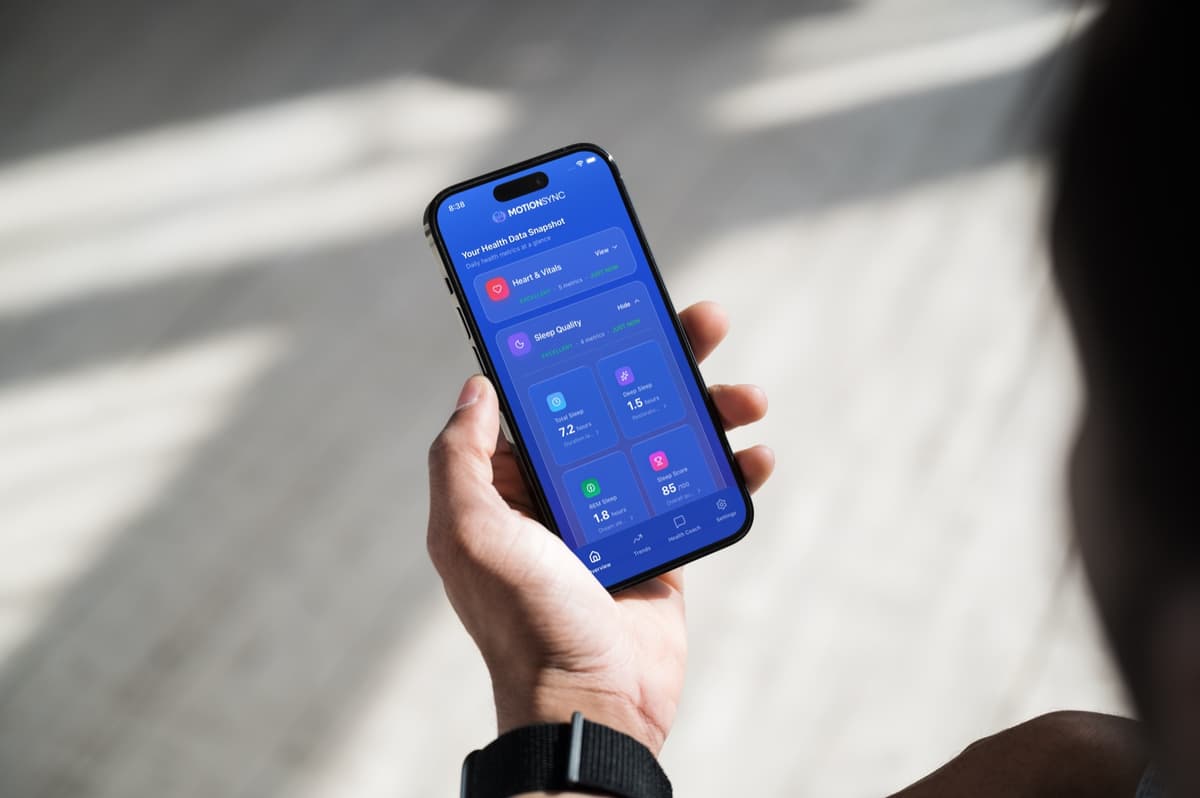
MotionSync connects directly to your wearables. ChatGPT Health reads from Apple Health and connected medical records on an iPhone. That one difference in architecture explains most of what separates the two tools day to day.
ChatGPT Health went from a limited preview to general availability for all eligible US users 18 and older, across every ChatGPT plan including Free, on July 23, 2026, on web and iOS (OpenAI, Health in ChatGPT). MotionSync is a purpose-built AI health coach designed from the ground up to connect wearables, track metrics, and give daily guidance. If you're deciding between the two, here's an updated, honest breakdown.
Does ChatGPT Health Connect Directly to My Garmin, Oura, or Fitbit?
No. ChatGPT Health has no direct wearable connections at all. It reads only from Apple Health, and a device's data reaches it only if that device's own app already shares into Apple Health first (OpenAI Help Center, What is ChatGPT Health?).
That means two gates, not one: what your Oura or Garmin app agrees to write into Apple Health, and then what you agree to share out of Apple Health into ChatGPT. OpenAI's own documentation is explicit that some app-specific numbers, like a proprietary sleep score, "may not transfer" through that path. There is also no Android app for ChatGPT Health, so Health Connect on Android isn't a route in at all right now.
MotionSync, by contrast, connects directly to Apple Watch, Oura Ring, Garmin, Fitbit, and Google Fit. If you own multiple wearables, say an Apple Watch for workouts and an Oura Ring for sleep, MotionSync pulls both into one unified view without routing everything through a single phone's health hub first.
| Integration | MotionSync | ChatGPT Health |
|---|---|---|
| Apple Watch | Direct | Via Apple Health |
| Oura Ring | Via Apple Health only | Via Apple Health (if synced) |
| Garmin | Direct | Via Apple Health (if synced) |
| Fitbit | Direct | Not supported, even indirectly |
| Google Fit | Direct | Not supported (no Android app) |
| Lab results | Not yet | Yes, via Function Health |
| Hospital medical records | Not yet | Yes, via Epic and Oracle Health systems |
Bottom line: if you use anything beyond an iPhone and Apple Watch, MotionSync gives you direct wearable coverage that ChatGPT Health's Apple Health-only path can't match. If your priority is pulling in hospital lab results and medical records alongside fitness data, that's a gap MotionSync doesn't fill today either, see below.
How Reliable Are ChatGPT Health's Conclusions About Your Data?
Mixed, and that matters more than feature lists. A Washington Post test gave ChatGPT Health a decade of Apple Watch data and asked for a simple A-to-F cardiovascular health grade. It returned an F. Asked again with the same data, the grade shifted between F and B across separate conversations (Washington Post, January 26, 2026). Eric Topol, a cardiologist at Scripps Research, called the analysis unreliable for medical decision-making and said the tool leaned too heavily on consumer wearable estimates like VO2 max, which vary by device and are rarely used alone to judge cardiovascular health (TechRepublic, January 28, 2026). The same report noted ChatGPT Health occasionally lost track of the user's basic details, like age and gender, across the conversation.
MotionSync takes a different approach. Instead of generating a one-off grade on request, it proactively delivers:
- Daily health summaries every morning, how you slept, your recovery status, what to focus on today
- Weekly insights showing your trends, what's improving, and what needs attention
- A metric overview that unifies heart rate, HRV, sleep, activity, and more in one dashboard
- Smart goal tracking that monitors progress and adjusts recommendations
- 24/7 AI chat when you have questions, grounded in your own data history, not a single data dump
The key difference: MotionSync builds your personal baseline over time, so an insight compares today against your own history rather than reconstructing a score from scratch each time you ask.
Daily Experience
This matters more than feature lists. What does it actually feel like to use each tool?
With ChatGPT Health, you open the ChatGPT app, go to the Health section, and either ask a question or let it draw on connected sources when relevant. It asks permission before using your connected health data in a given response, one request at a time or all at once (OpenAI Help Center). There's no standing dashboard waiting for you each morning. It's reactive: it works when you initiate.
With MotionSync, you open the app and your day's health picture is already there. Your daily summary tells you how you slept, how recovered you are, and what to prioritize. If you want to dig deeper, you ask the AI coach a question grounded in your full history.
| Experience | MotionSync | ChatGPT Health |
|---|---|---|
| Daily summary | Automatic, every morning | None, you have to ask |
| Health dashboard | Yes, real-time | Yes, but Apple Health-sourced only |
| Goal tracking | Automatic | No |
| Weekly insights | Yes | No, you have to ask |
| AI chat | 24/7, your data plus baseline | Chat-based, per-session |
| Proactive alerts | Yes | No |
Bottom line: MotionSync is built for daily use. ChatGPT Health is a tool you reach for when you have a specific question or a medical record to review.
Data Privacy and Security
Both platforms take privacy seriously, but with different scope and tradeoffs.
ChatGPT Health isolates health conversations and does not use connected health data to train OpenAI's foundation models, according to OpenAI. Health is only available on web and iOS, in the US, to users 18 and older. Reporting has also raised a structural concern worth knowing: because ChatGPT Health is a consumer product and not a HIPAA covered entity, medical records that enter it lose the specific protections they had inside a hospital's own system, even though OpenAI applies its own stated safeguards (Startup Fortune, July 2026).
MotionSync encrypts your health data in transit and at rest, stores it in the US, and never sells it. Insight generation runs inside a hardware-secured enclave at our AI provider, a setup designed so the provider cannot see your prompts or results, and never receives your name, email, or other account identifiers. You choose which data types to share through per-type toggles, and turning one off stops that category from being read.
Worth noting: neither product is a HIPAA covered entity in the traditional sense. Consumer health apps that pull from wearables generally fall under the FTC's Health Breach Notification Rule instead, which requires notifying you if your data is exposed or shared without authorization (FTC, Health Breach Notification Rule). The practical difference is in the defaults: MotionSync collects only the categories you turn on, and ChatGPT Health's health conversations depend on what Apple Health and your connected record systems choose to expose.
Where ChatGPT Health Wins
Let's be fair. ChatGPT Health has strengths MotionSync doesn't have yet:
- Hospital medical records and lab results. ChatGPT Health connects to Function Health for lab work and to hospital systems through Epic and Oracle Health, plus One Medical. MotionSync focuses on wearable and activity data, not clinical records.
- Breadth of general health knowledge. For questions that aren't about your personal data, "what foods help lower blood pressure," it draws on a much broader base.
- Free on every plan. ChatGPT Health is included on the Free, Go, Plus, and Pro tiers. MotionSync is a free 14-day trial, then free or Pro.
Where MotionSync Wins
- Direct multi-wearable support. Apple Watch, Garmin, Fitbit, and Google Fit connect without routing through a single phone's health hub, unlike ChatGPT Health's Apple Health-only path.
- Works on Android. ChatGPT Health has no Android app; MotionSync does not require an iPhone.
- Purpose-built for daily health. Dashboard, daily summaries, weekly insights, goal tracking, all automatic.
- Proactive, not reactive. You don't have to ask. MotionSync surfaces what matters, when it matters.
- Consent per data type. Turn sleep, heart rate, activity, or vitals sharing off at any time, and that category stops being read.
Which Should You Choose?
Choose ChatGPT Health if you want to review lab results or hospital medical records alongside occasional health questions, you're on an iPhone, and you're comfortable with a chat-first experience rather than a daily dashboard.
Choose MotionSync if you wear one or more fitness trackers, especially a Garmin, Oura, or Fitbit, or you're on Android, and you want an AI health coach that works for you every day rather than one you have to remember to open.
For most people actively tracking their health with wearables, MotionSync fills the gap ChatGPT Health's architecture leaves open: a daily, cross-device view that doesn't depend on a single phone's health hub to work.
Ready to see your health data in one place? Download MotionSync, free 14-day trial, then free or Pro.
Related Articles:
About the author

Written by MotionSync Team
Editorial Team
The MotionSync editorial team writes about wearable data, recovery, sleep, and heart health in plain English. Articles draw on peer-reviewed research and the metrics your wearable already tracks. Content is for general education and is not a substitute for medical advice.