Why Apple Health Falls Short for Serious Trackers
Apple Health is the world's largest health data repository. Over 100 million Americans wear health-tracking devices, and for most iPhone users, Apple Health is the default destination for that data. It receives heart rate readings from your Apple Watch, sleep data from your Oura Ring, workout logs from Strava, and weight measurements from your smart scale.
And then it does almost nothing with any of it.
Apple Health is a filing cabinet — comprehensive, well-organized, and completely passive. For someone who just wants their data stored securely, that's fine. But if you're a serious tracker trying to understand what your data means and what to do about it, Apple Health has a fundamental problem: it stores everything and explains nothing.
And here's the thing — Apple knows it.
Apple Admitted the Problem
In February 2026, Bloomberg reported that Apple quietly shut down "Project Mulberry" — a years-long effort to build an AI-powered health coaching subscription service. The project had its own studio in Oakland for recording wellness content. It was supposed to launch as "Apple Health+" in spring 2026.
What happened? Eddy Cue, Apple's new head of the health division, compared what they'd built to the competition and concluded it wasn't good enough. According to Bloomberg, Cue told colleagues that "Apple needs to move faster and be more competitive in health" and that "newer rivals — including Oura and WHOOP — offer more compelling and useful features."
The AI health coach was dismantled. Instead, Apple plans to roll out individual features incrementally over time. No cohesive product. No launch date. Just pieces, eventually.
If you're waiting for Apple to solve the health intelligence problem, you're going to be waiting a while.
What Apple Health Actually Does Well
To be fair, Apple Health has real strengths that deserve acknowledgment.
Privacy is exceptional. All health data is encrypted on-device with end-to-end encryption for iCloud sync. Apple's HealthKit API explicitly prohibits developers from using health data for advertising. No other platform comes close to Apple's structural privacy protections.
The installed base is massive. Apple Watch is the most-owned wearable device (44% of wearable owners), and Apple Health is the default health hub for every iPhone. HealthKit integration means third-party apps can read and write data with user permission.
Clinical-grade features exist. ECG detection, atrial fibrillation alerts, fall detection, and Blood Oxygen monitoring are genuinely useful — in some cases, life-saving. These hardware-level capabilities are hard to replicate in software alone.
On-device processing keeps data local. Where Apple Intelligence features apply, analysis happens without data leaving your phone.
These are real advantages. But they don't address the core problem: Apple Health collects an enormous amount of data and offers almost no help understanding it.
Where Apple Health Falls Short
No AI Analysis
Apple Health shows you charts. Lots of charts. Your heart rate over time, your step counts by day, your sleep duration by week. What it doesn't do is tell you what any of it means.
Your HRV dropped 20% this week. Is that a problem? Apple Health won't say. Your resting heart rate has been climbing for 10 days. Should you be concerned? Apple Health shows the trend line but offers no interpretation.
A UX researcher studying Apple Health described the navigation as "unintuitive and unpredictable, with information feeling scattered, redundant, or buried, forcing users to work too hard to find meaning." The data is there. The understanding isn't.
No Cross-Device Intelligence
Here's where it gets particularly frustrating for serious trackers. If you wear an Oura Ring for sleep and an Apple Watch for activity, Apple Health receives raw data from both. Heart rate samples, sleep blocks, step counts — all dutifully stored.
But Apple Health never connects the dots. It won't tell you that your poor sleep last night (tracked by Oura) correlates with your elevated heart rate today (tracked by Apple Watch). It won't notice that your HRV drops every Monday — possibly because of your Sunday evening routine. It stores each data stream separately and leaves the analysis to you.
The same metric can mean entirely different things depending on the device. Each wearable uses different algorithms, sensors, and scoring systems. An Oura Readiness Score and a Garmin Body Battery score both reflect recovery — but they're calculated differently and can't be compared directly. Apple Health stores the raw inputs but has no framework for synthesizing them.
No Proactive Recommendations
Apple Health provides general reminders — "time to stand," "you haven't logged a workout today." These are helpful nudges, but they're generic. They're the same for a marathon runner and someone who just started walking.
What serious trackers need is contextual guidance: "Your HRV has been declining for five days while your training load increased. Consider a recovery day before your next hard session." That requires understanding your baseline, tracking your patterns, and knowing what's normal for you. Apple Health doesn't do any of that.
No Persistent Health Profile
Apple Health tracks your data over time, but it doesn't build a profile of your normal. It can show you that your resting heart rate was 58 BPM last night, but it doesn't know whether 58 is typical for you, elevated, or a sign of improvement.
Without a baseline understanding of the individual, every data point exists in a vacuum. And data in a vacuum is noise.
The ChatGPT Health Experiment (and Why It Failed)
OpenAI tried to solve this gap by connecting ChatGPT to Apple Health data. In theory, it made sense: give a powerful AI access to your health metrics and let it analyze them.
In practice, it didn't work. A Washington Post investigation in January 2026 fed ChatGPT 10 years of Apple Watch data — 29 million steps, 6 million heartbeat measurements. When asked to grade the person's cardiac health, the score swung wildly between an F and a B on repeated queries with the same data.
Cardiologist Eric Topol of Scripps Research called ChatGPT's health analysis "baseless" and said people should ignore its medical advice.
The fundamental problem: ChatGPT is a general-purpose AI that happens to access your health data. It starts fresh every conversation. It has no persistent understanding of your baselines, trends, or patterns. It doesn't know what's normal for you. And it can't proactively alert you when something changes — you have to ask.
Bolting general-purpose AI onto passive health data doesn't produce health intelligence. It produces inconsistent answers.
What Serious Trackers Actually Need
If you're someone who wears multiple devices, checks your metrics daily, and genuinely wants to use that data to improve your health, here's what the current ecosystem is missing:
Unified cross-platform view. Not just storing data from multiple sources — actually synthesizing it. Understanding that your Oura Ring sleep data, Apple Watch activity data, and Garmin training data are all part of the same picture.
AI that knows your baseline. An AI that builds a persistent health profile over time. One that knows your typical HRV range, your normal resting heart rate, your usual sleep patterns — and can flag when something deviates.
Proactive insights, not reactive queries. Instead of waiting for you to ask "how's my recovery?" — surfacing patterns and recommendations when they're relevant. "Your sleep quality and HRV both dipped this week. That combination usually means your body is fighting something off."
Plain English explanations. Not "your RMSSD was 42 ms" but "your nervous system recovery is below your usual baseline. Consider a lighter workout today."
Privacy without sacrifice. Encrypted in transit and at rest, no data selling, per-type consent toggles, and intelligent analysis. The two aren't mutually exclusive.
Why This Gap Exists (and Who's Filling It)
Apple's incentive structure makes this gap predictable. Apple Health exists to make Apple hardware more valuable — it's a feature of the ecosystem, not an independent health intelligence product. Building a truly comprehensive health platform would mean supporting competitors' devices (Garmin, WHOOP, Fitbit) as first-class citizens, which runs counter to Apple's walled-garden strategy.
Several companies are trying to fill this gap. Bevel, with $10 million in Series A funding and 100K+ daily users, positions itself as "turning your Apple Watch into a WHOOP." ONVY connects 500+ health sources with AI analysis. Each takes a different approach to the same fundamental problem: health data without intelligence is just noise.
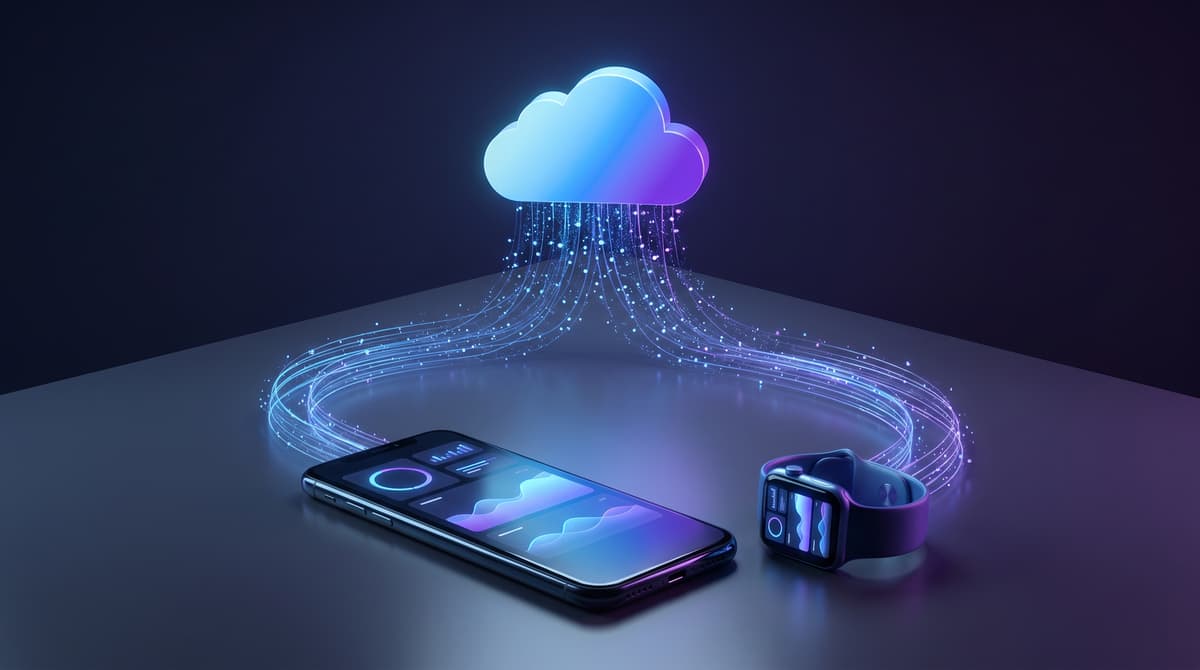
MotionSync approaches it differently. We connect all major wearable platforms — Apple Health, Garmin, Oura Ring, Fitbit, Google Fit, with WHOOP and Strava coming soon — into one unified view. The AI health coach builds a persistent profile of your baselines, spots cross-device patterns you'd never see in isolation, and explains what your data means in plain English. No prompting required. No starting fresh every conversation.
Your Apple Watch tracks the data. Your Oura Ring records the data. MotionSync explains what it all means — and tells you what to do next.
It works with the devices you already own, so there's no new hardware to buy.
Related Articles:
About the author

Written by MotionSync Team
Editorial Team
The MotionSync editorial team writes about wearable data, recovery, sleep, and heart health in plain English. Articles draw on peer-reviewed research and the metrics your wearable already tracks. Content is for general education and is not a substitute for medical advice.