What does an AI health coach actually do?
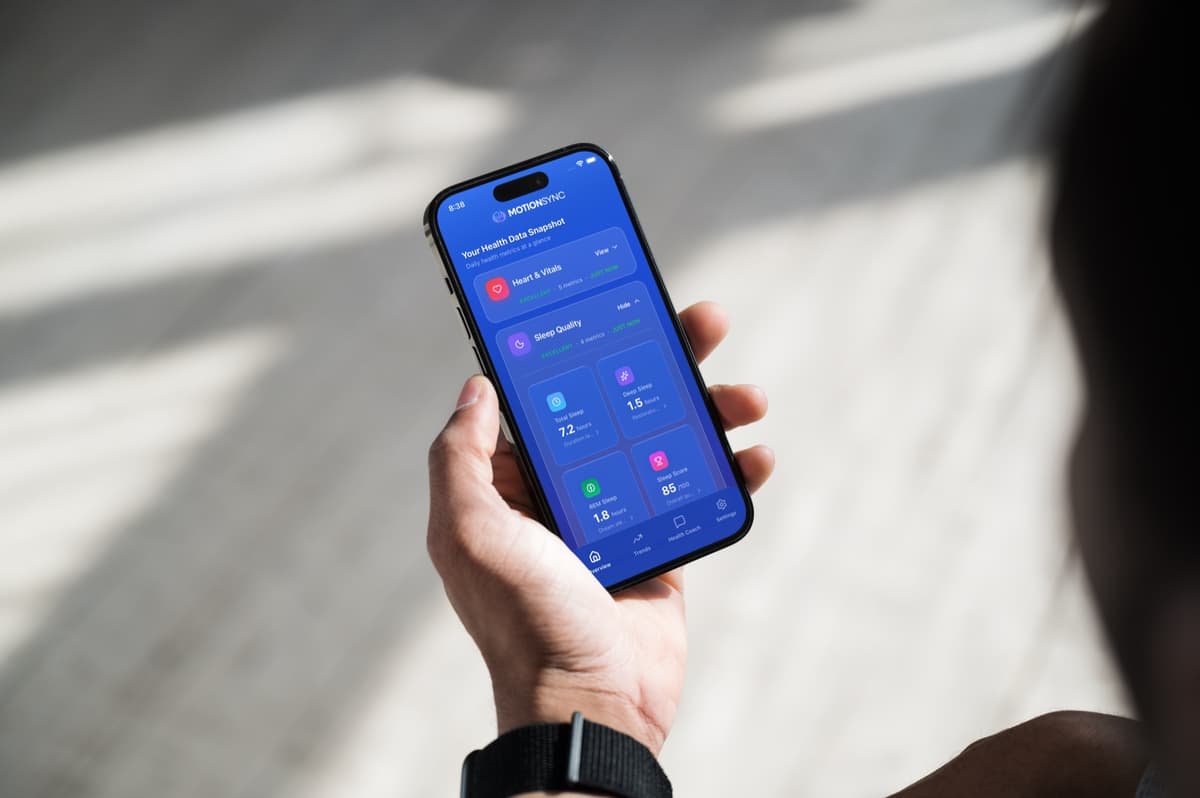
An AI health coach pulls data from the wearables you already wear, such as a smartwatch or ring, and turns raw numbers like HRV or sleep stages into plain language you can act on. MotionSync is built specifically for this: one dashboard instead of several disconnected apps, with AI insights grounded in your own data instead of generic advice.
Why does switching between health apps feel exhausting?
Most people managing their health are not using one tool, they are juggling several. A KFF Health Tracking Poll found that 51% of people who have used health care apps report using multiple apps, websites, or accounts to manage their health care, rising to 55% among those 65 and older (KFF, 2025). A separate 2026 survey of insured adults found the average person uses six different health-related apps regularly, with one in five using ten or more, and nearly half reporting burnout from managing them (Digital Information World, 2026).
The problem is not that any single app is bad. It is that your sleep tracker, your heart rate monitor, and your activity log were never built to talk to each other, so you end up doing the integration work yourself, mentally stitching together a sleep score from one screen and a recovery number from another.
Why do my health apps give me conflicting numbers?
Different wearables use different sensors, sampling windows, and proprietary formulas, so even the same metric, like HRV or sleep duration, can come back with different values from different devices on the same night. We cover why that happens in detail in our guide on why wearables show different HRV numbers. The short version: more apps does not mean more clarity, it often means more numbers to reconcile yourself.
How does MotionSync bring everything into one place?
MotionSync connects to the wearables you already own, including Apple Watch, Oura Ring, Garmin, Fitbit, and Google Fit, and pulls that data into a single dashboard. Instead of opening four apps before breakfast, you open one.
A dashboard built around your own baselines
Your heart rate, sleep quality, step count, and activity levels update in one place, compared against your own recent history rather than a population average. Raw numbers on their own are close to meaningless. A readiness score of 67 or an HRV of 42ms tells you very little without knowing what is normal for you specifically. We go deeper on why context matters more than more data in why your wearable data means nothing without context.
An AI coach that explains what the numbers mean
Instead of staring at an HRV chart wondering if 42ms is good or bad for you, MotionSync's AI coach describes what changed and a plausible reason, grounded in your own data: your HRV was lower than your recent average last night, which commonly follows a late workout, a stressful day, or a late meal.
A daily summary instead of a dozen screens
Each morning, MotionSync delivers a summary of your sleep quality, recovery status, and activity from the day before, so you know where you stand without digging through separate charts for each metric.
Ask it questions about your own data, any time
You can ask MotionSync's AI coach why your heart rate was high last night, or whether you are recovered enough to train today, and get an answer based on your actual recent trend rather than a generic search result.
What can an AI health coach actually tell me, and what can't it?
This distinction matters more than any feature list. An AI health coach built on your wearable data can:
- Describe trends in your own metrics over days or weeks
- Flag when something is outside your personal normal range
- Connect related changes across sleep, heart rate, and activity
It cannot diagnose a medical condition, replace a clinician, or tell you with certainty what is causing a change in your data. A pattern consistent with poor recovery is not the same as a medical finding. If a trend persists or concerns you, that is a reason to talk to a doctor, not a reason to rely on the app's wording alone. We go into this gap in more detail in how AI and wearables fill the gaps your doctor cannot, and in why your AI health coach can sometimes say things your data doesn't support.
How is this different from asking ChatGPT about my health?
A general-purpose chatbot starts from zero in every conversation and answers from population-level patterns. MotionSync is purpose-built for wearable data: it connects directly to your devices, builds a profile of your own baselines over time, and is designed so your data is used only to generate your insights, not for advertising or resale. See our full comparison in MotionSync vs ChatGPT Health.
What changes before and after consolidating into one app?
| Before | After |
|---|---|
| Several disconnected apps | One dashboard |
| Manually cross-referencing numbers | Metrics compared automatically against your own history |
| Conflicting scores across devices | One unified view of your trends |
| Raw charts with no explanation | Plain-language insights tied to your own data |
Getting started
- Download MotionSync.
- Connect the wearables you already use: Apple Watch, Oura, Garmin, Fitbit, or Google Fit.
- Set what you want to focus on, whether that is sleep, activity, recovery, or all three.
- Ask your first question, such as "how was my sleep last night," and see how the AI responds using your own data.
MotionSync is in early beta, available in the US for now while we build out the legal and privacy foundation for a wider release. Try the free 14-day trial, then stay on the free tier or move to Pro.
FAQ
Does MotionSync replace my existing wearable's app?
Not entirely. Your wearable's own app still handles device settings and firmware. MotionSync sits on top as the place where all your devices' data comes together and gets explained in one view, instead of being locked in separate silos.
Can MotionSync diagnose a health condition?
No. MotionSync's AI coach describes patterns and trends in your own data and is not a diagnostic tool. Bring any persistent or concerning pattern to a healthcare provider rather than treating an AI insight as a medical conclusion.
How many devices can I connect at once?
MotionSync currently supports Apple Health, Oura, Garmin, Fitbit, and Google Fit, and you can connect more than one at a time. Connecting more sources generally gives the AI more context to compare across sleep, heart rate, and activity.
- AI health coach
- all-in-one health app
- replace health apps
- wearable integration
About the author
Written by MotionSync Team
Editorial Team
The MotionSync editorial team writes about wearable data, recovery, sleep, and heart health in plain English. Articles draw on peer-reviewed research and the metrics your wearable already tracks. Content is for general education and is not a substitute for medical advice.